 Cameron Armstrong
The Last Brief: An Open Playbook for the Agency of the Future
1. Who am I & why am I writing this?
I joined the advertising industry as an apprentice. No degree, no connections, just a curiosity about how advertising actually works and a willingness to do as much work as humanly possible to find out.
I fell in love with the industry almost immediately. The creativity, the strategy, the sheer scale of what a good campaign can do to a business. I still love it. I want to be clear about that before anything else in this piece, because what follows might sound like I don't.
But from the very early days, something felt off...
I remember in my first few months, watching a client brief move through the agency.
A planner received it. The planner wrote a strategy document that reinterpreted the brief for the next person in the chain. That document went to a buyer, who translated the strategy into a media plan. The plan went to an activation team, who translated the plan into platform settings. The execution generated data, which went to a reporting team, who translated the data into a deck. The deck went back to the client, who read it, misunderstood half of it, and wrote a new brief.
I was seventeen years old and I could see what was happening. Every person in that chain was carrying information from one place to another. The thinking happened in flashes. The rest was routing.
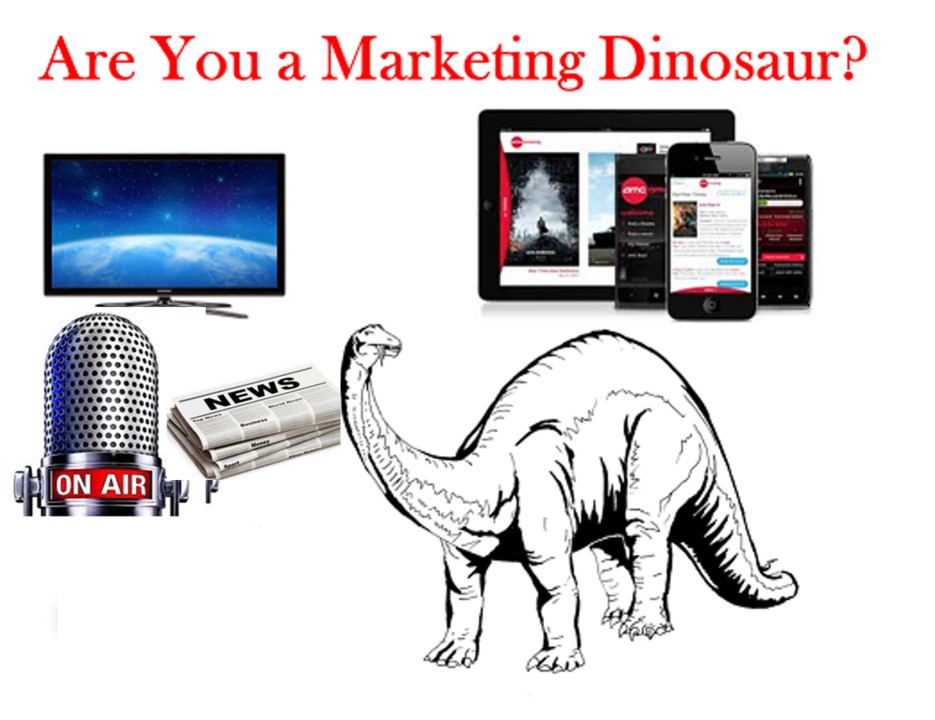
It was like watching a dinosaur. A very well-dressed dinosaur, with nice offices and good catering and a lot of people who were genuinely brilliant at their jobs. But a dinosaur.
I didn't say anything at the time, because you don't say that when you're young. You learn the system, you get good at it, you earn the right to have an opinion. So that's what I did.
But since then a lot has changed. I've been fortunate enough to do pieces of work I never thought I'd do when I joined the industry at 17. But it's not advertising and media which has taken all of my thinking time recently. The one thing I can't get out of my mind is the changing world order.
I've been researching and building obsessively. And seeing how fast the world around us is changing, I couldn't resist writing about what it means for us in advertising and media.
2. Why do we as Marketers think change doesn't apply to us?
In 1962, David Ogilvy wrote that the best advertising agency in the world would be one that “finds out what the client wants and then gives him something better.” Not what the client asked for. Something better. The implication was that the agency’s job was not obedience. It was judgment.
Sixty years later, most agencies have replaced judgment with process. And process, left unchecked, has replaced thinking with routing.
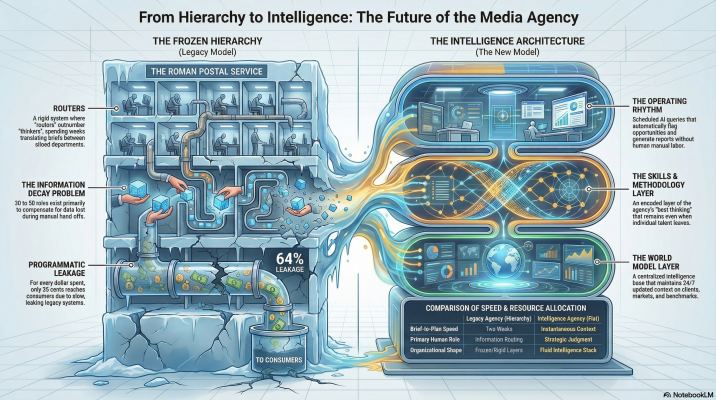
This is not a media agency. This is the Roman postal service.
And like most things that have been running the same way for a long time, nobody questions the cost. The ANA found that for every dollar spent in programmatic, only 36 cents reaches an actual consumer. Seven in ten campaigns fail to generate a meaningful return. The vast majority of digital ads don't clear the memory threshold, served, counted, invoiced, forgotten. The system isn't just slow. It's leaking.
The Romans built a postal service around 20 BC. The cursus publicus. Relay stations, fresh horses, roads spanning three continents. Messages could travel 80 kilometres a day, which was fast. And for the next eighteen centuries, not much changed. A letter sent in 1800 moved at roughly the same speed as one sent in 100 AD. Different horses. Same paradigm.
Then the telegraph arrived, and a message could cross a continent in minutes. Thirty years later, the telephone. Sixty years after that, the first commercial flight. Sixty-six years separated the Wright Brothers at Kitty Hawk and Neil Armstrong on the moon.
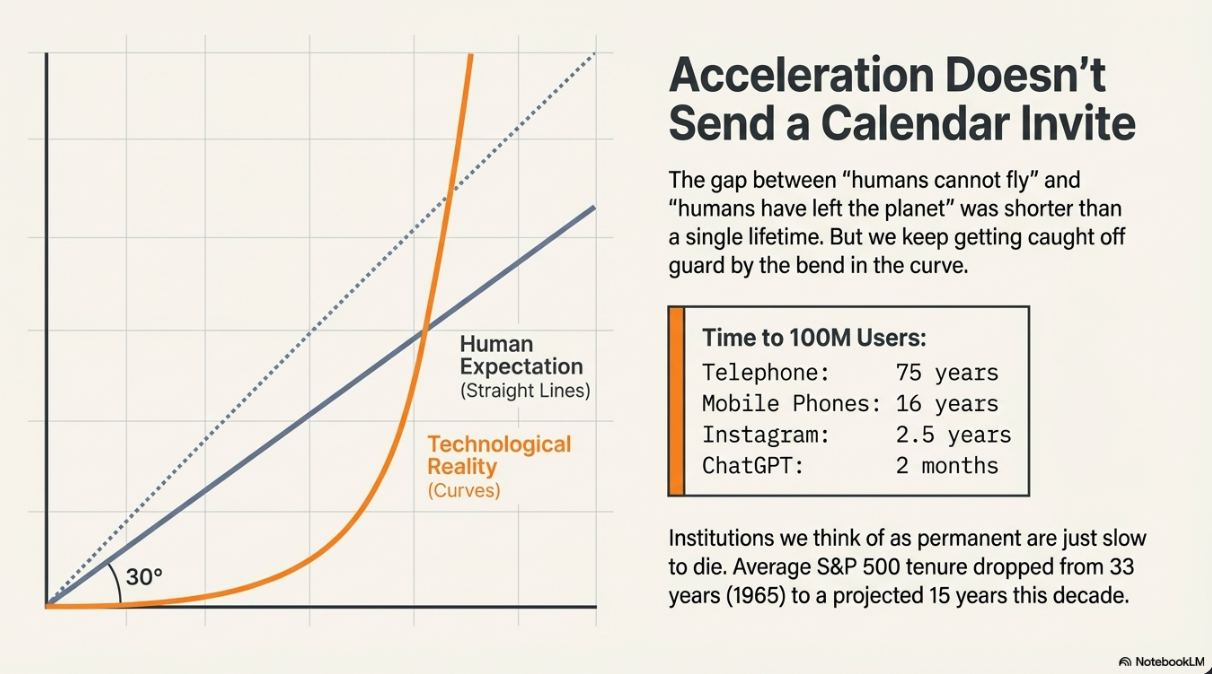
The gap between "humans cannot fly" and "humans have left the planet" was shorter than a single lifetime. Think about that for a second...
This is the part people struggle with. Not the change itself. The acceleration. Our brains think in straight lines. The world moves in curves. And we keep getting caught off guard by the bend. The telephone took 75 years to reach 100 million users. Mobile phones took 16 years. Instagram took 2.5 years. ChatGPT did it in two months. General Motors took 67 years to reach a billion-dollar valuation. Google took 8. Uber took 4. Some AI companies have done it in under a year. The average company on the S&P 500 stayed there for 33 years in 1965. By 2020, it was 21. The projection for this decade is 15.
The institutions we grew up thinking of as permanent are not permanent. They're just slow to die.
There's an analogy I keep coming back to. Imagine a bathtub full of water. Hit the surface with a hammer and it slips through. Now freeze the water and strike again. The surface barely moves. Same molecule, different state. As companies grow larger, the binding forces get stronger. Too many layers, too many processes, too many people whose job is to make sure nothing goes wrong. The organisation stops being fluid and starts being rigid. That's what happened to most agencies. They didn't get worse. They froze.
Retail got disrupted. Taxis got disrupted. Banking got disrupted. Publishing got disrupted. Media agencies watched all of this happen and assumed they were spectating, not previewing. The brief still took two weeks to become a media plan, the same way it did in 1998. Nobody seemed to think that was a problem.
The thing about acceleration is that it doesn't send a calendar invite. It accumulates quietly, in the tools people use after hours, in the side projects nobody talks about in the Monday status meeting, in the gap between what's possible and what the org chart permits.
Then one day someone writes an essay and cuts 40% of their company, and everyone acts as if it came from nowhere.
3. What does the new world order look like?
That someone was Jack Dorsey. In March 2026, he and Roelof Botha published "From Hierarchy to Intelligence." The argument was ruthless: corporate hierarchy has always existed to solve one problem. Routing information through organisations too large for any single person to oversee. Managers aggregate context from below, act as messengers from above, and maintain alignment. That's it. Every layer in every org chart is a human being doing the work of a relay tower.
Dorsey then asked the question nobody in a management position wants to hear: what happens when a machine can do the relaying?
He cut 4,000 people. 40% of Block. Not because the business was failing. Because the business was growing, and the hierarchy had become the bottleneck, not the engine. The stock went up 20%.
I read that essay at 11pm on a Monday night when it came out. Then I read it again. Because I realised, what I feared, was starting to truly unfold.
4. What would this look like for a media agency of the future?
Imagine a brief arrives at 9am on a Monday. It's for a general insurance brand. The budget is meaningful but not unlimited. The objective is growth, not just activation. There are incumbents to outperform, a category drowning in sameness, and a CEO who needs to see return within two quarters.
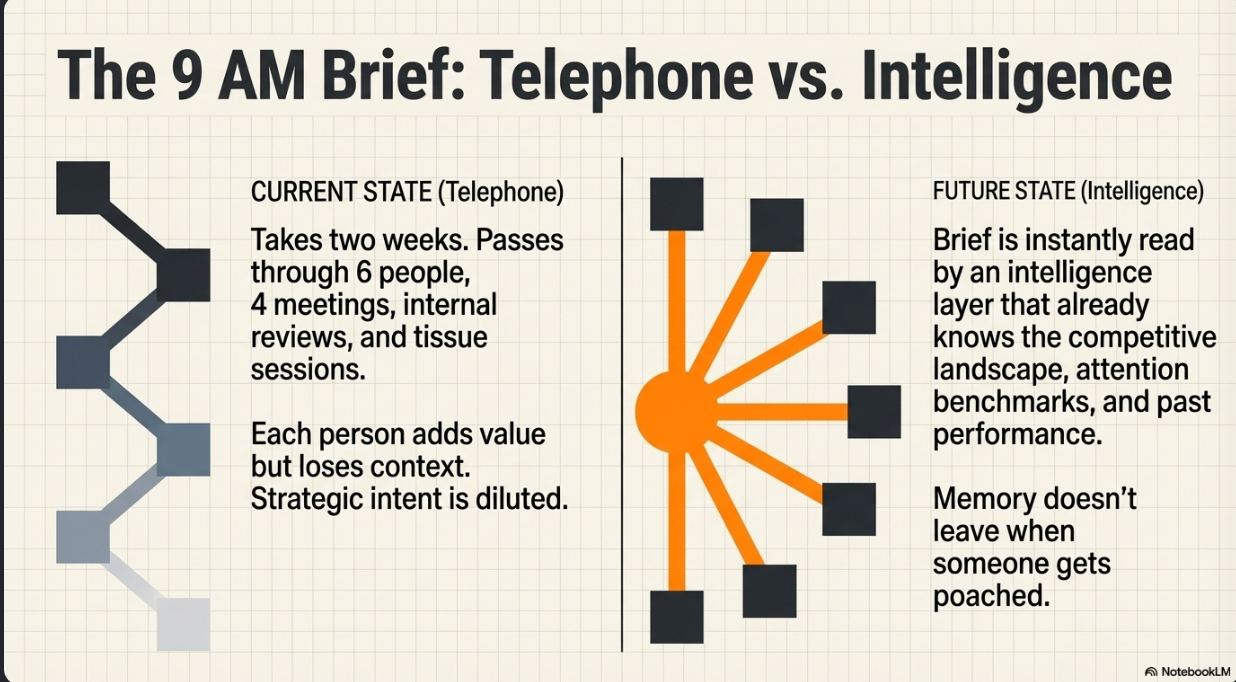
In today's agency, this brief takes two weeks to become a plan. It passes through six people, four meetings, two rounds of internal review, one "tissue session" with the client, and a RTB deck that nobody reads in full. Each person adds some value and loses some context. By the time the plan reaches execution, the original strategic intent has been diluted by the game of telephone that produced it.
Recommended by LinkedIn


Now imagine a different agency. One where the brief arrives and is immediately read by an intelligence layer that already knows this client's competitive landscape, because it updated itself last Monday. It already knows the attention benchmarks for every channel in the plan, because it compiles them monthly. It already knows what worked and what didn't in the last three campaigns, because it was there, and it remembers everything, and its memory doesn't leave when someone gets poached.
In this agency, the planner doesn't spend three days pulling data and building a competitive context slide. The context already exists, compiled and current, waiting to be queried. The planner's job is not to assemble information. It's to exercise judgment about what the information means.
The buyer doesn't spend a day building a reach curve in a spreadsheet. The reach architecture already exists as a living model. The buyer's job is not to calculate. It's to decide where the model is wrong and why.
The activation team doesn't re-key campaign settings from a Excel into a DSP. The campaign structure flows from plan to platform through a pipeline designed once and working every time. The activation team's job is not to type. It's to watch, to intervene, to catch what the system cannot.
And the reporting team doesn't exist. Because reporting is not a human activity. It's a query against a system that already knows what happened, already knows what it means, and already knows what to do next. The report writes itself. The human decides whether to act on it.
Every piece of this technology exists today. I know because I've been building with it. What doesn't exist, in most places, is the willingness to admit what it implies.
What it implies is this: the modern media agency has three to five roles per client that actually require a human brain, and thirty to fifty roles that exist to compensate for the fact that information decays every time it passes through a person.
That's not a criticism of the people in those roles. It's a criticism of the system that made those roles necessary. Nobody wakes up wanting to be a relay tower. They wanted to be a strategist, a creative, a thinker. The hierarchy turned them into messengers.
There's something else I keep thinking about. I got into this industry because someone took a chance on a seventeen-year-old. The grunt work I did in those early years; pulling reports, updating trackers and reconciliations, formatting decks late at night, taught me how everything connects. From the campaign settings in a DSP to the number on the client's P&L. That grounding shapes everything I do now.
If we automate the routing and only keep the judgment roles, we solve the efficiency problem. But we risk destroying the pathway that produces the next generation of people with that judgment. Junior roles vanish. Apprentice work gets automated. The entry points disappear. We need to be deliberate about what replaces them.
What it implies is this: the modern media agency has three to five roles per client that actually require a human brain, and thirty to fifty roles that exist to compensate for the fact that information decays every time it passes through a person.
That's not a criticism of the people in those roles. It's a criticism of the system that made those roles necessary. Nobody wakes up wanting to be a relay tower. They wanted to be a strategist, a creative, a thinker. The hierarchy turned them into messengers.
5. Would the greats agree?
One thing I love doing with AI is speaking to the greats and asking what they would do? Well you can ask them...
Ogilvy would have seen this for what it is. He spent his career arguing for the importance of the individual over the department, the person with taste and judgment over the process that protected against their absence. He never got the tool that would prove him right. We have it now. An intelligence layer doesn't replace the individual. It removes everything that was standing between the individual and the work.
Leo Burnett said the greatest thing to be achieved in advertising is believability, and nothing is more believable than the product itself. His genius was looking at the thing everyone else was trying to dress up, and deciding to undress it instead. The Jolly Green Giant was not a branding exercise. It was the product, made into a character, standing in a field. No routing. No abstraction. No six-person chain between the truth and the audience. Burnett wanted zero distance between the idea and the customer. AI is the first technology that actually closes that gap at scale.
Walt Disney's version was different again. People remember the imagination. They forget how he worked. He was not a delegator. He was an orchestrator. He sat in the middle of a system where every animator, every musician, every set designer could see the whole picture, not just their piece of it. Fantasia was not made by a hierarchy. It was made by a group of people who all understood what the film was trying to be, because one person made sure they did. A world model does what Disney did in that room, except it never forgets, never gets tired, and scales to every client on the roster simultaneously.
Steve Jobs took this further. Apple under Jobs was famously flat in ways that would terrify a media agency holding company. Jobs didn't believe in layers. He believed in taste. He believed that if you hired people with enough judgment, you didn't need process to protect you from their mistakes. You needed process to get out of their way. That's what an AI skills layer does. It encodes the best thinking so that the process serves the thinker, not the other way around.
The agency of the future looks more like Disney's animation studio or Jobs's product team than it does like a Roman legion. Individual contributors with deep skills and shared context, working against a model of the world that is maintained by intelligence, not by managers.
No permanent middle layer. No context loss. No game of telephone.
6. Can we build the future?
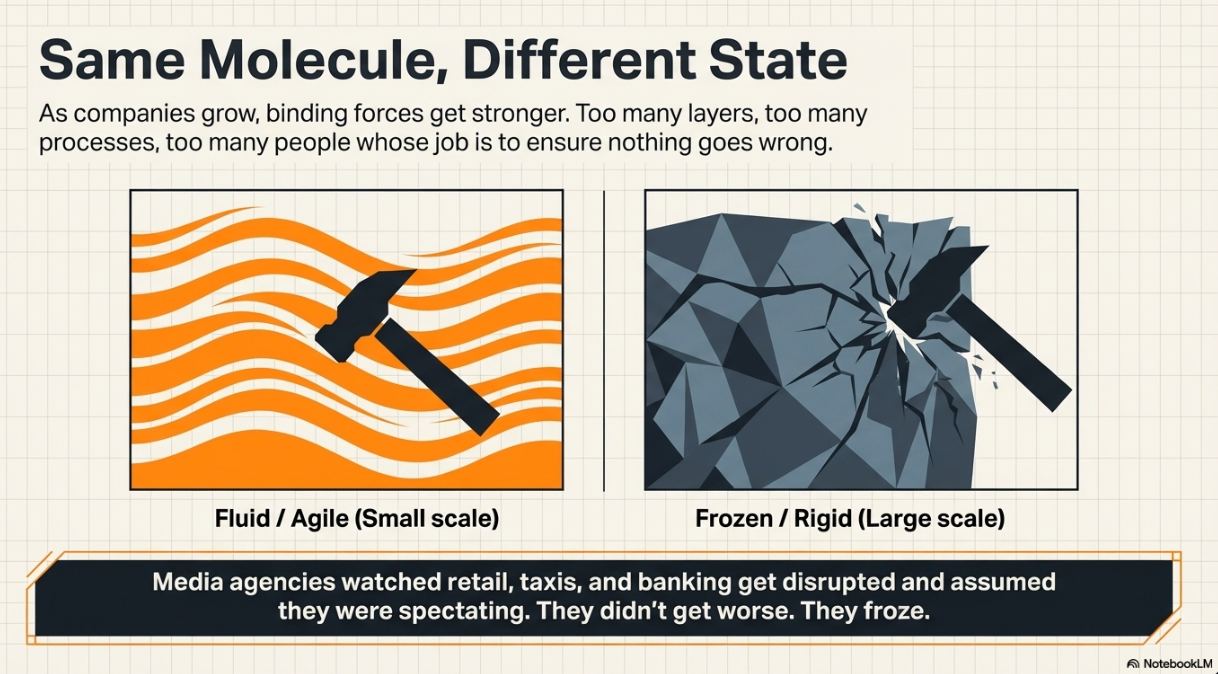
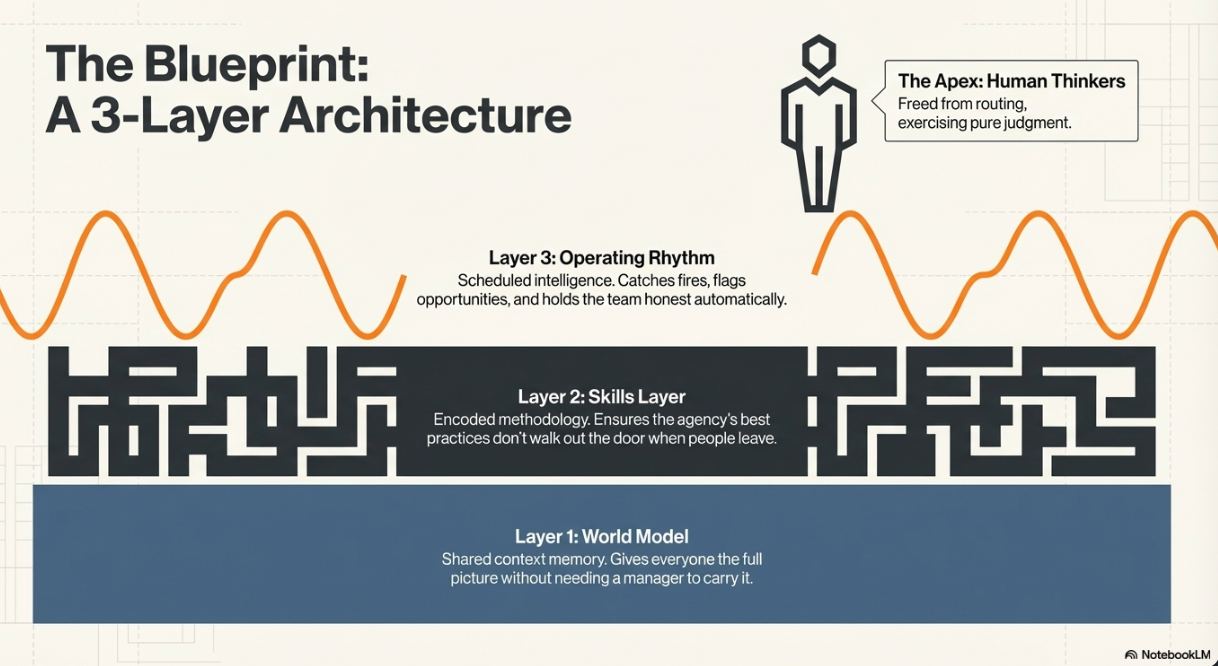
So what actually replaces the hierarchy? Three layers. A world model that gives everyone the full picture without needing a manager to carry it. A skills layer that encodes the agency's best methodology so it doesn't walk out the door when people leave. And an operating rhythm of scheduled intelligence that catches fires, flags opportunities, and holds the team honest, all without being asked.
Each of these deserves its own deep dive, and I'll write them. But the point here isn't the architecture. It's the principle: AI doesn't replace the thinking. It replaces the routing. And when you remove the routing, the thinkers can finally do what they were hired to do.
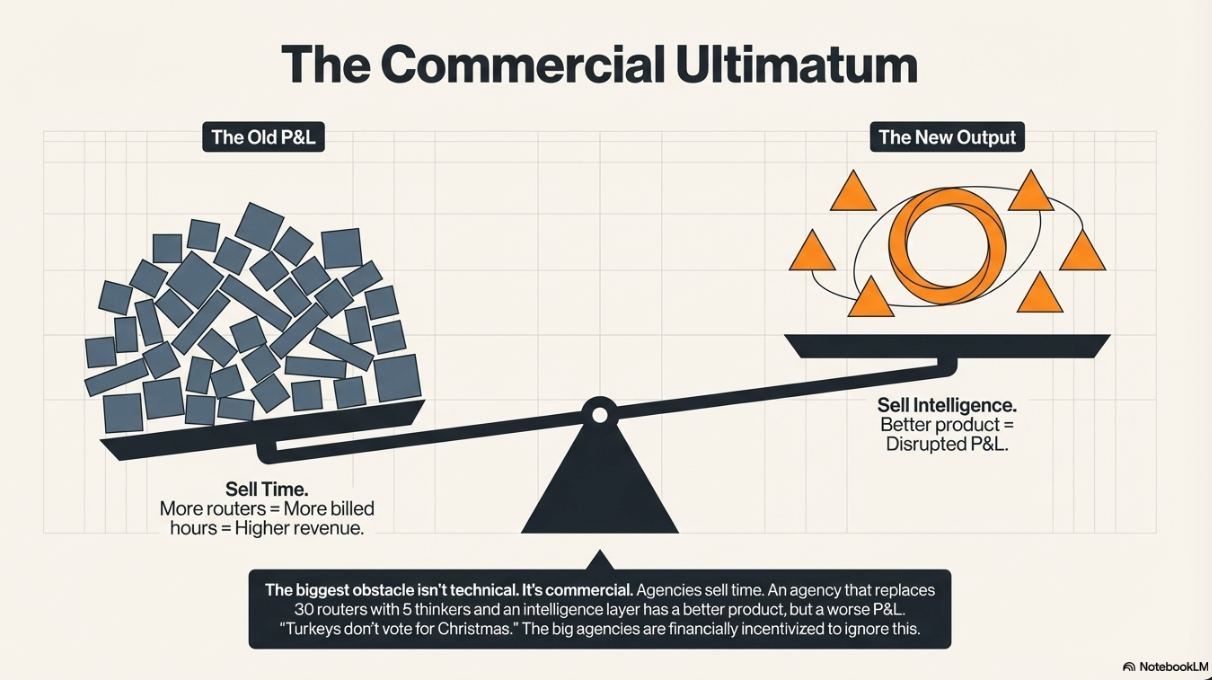
I won't pretend there aren't obstacles. The biggest one isn't technical. It's commercial.
Agencies sell time. More people on the account, more hours billed, more revenue recognised. An agency that replaces thirty routers with five thinkers and an intelligence layer has a better product and a worse P&L. Turkeys don't vote for Christmas.
But someone will do it anyway. A smaller agency, or a team within a bigger one, or a new entrant nobody's heard of yet. Someone will look at the gap between what's possible and what's being done, and they'll build the thing.
That's why I'm writing this as an open playbook, not a pitch deck. The change is coming whether agencies want it or not. I'd rather the people inside agencies are the ones who build it, instead of being the ones it happens to.
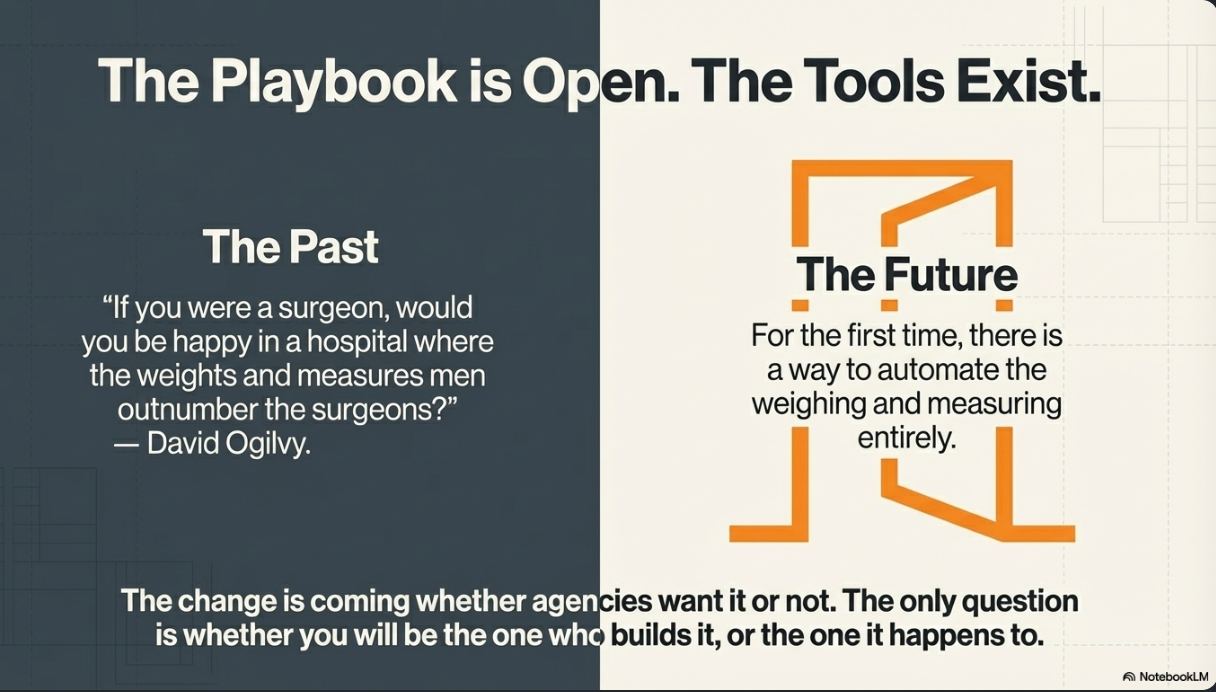
Ogilvy wrote sixty years ago: "In most agencies, account executives outnumber the copywriters two to one. If you were a surgeon, would you be happy in a hospital where the weights and measures men outnumber the surgeons?"
The weights and measures men still outnumber the surgeons. But for the first time, there's a way to automate the weighing and measuring entirely.
The playbook is open. The tools exist. The question isn't whether this will happen. It's whether you'll be the one who builds it.