 Cameron Armstrong
After 2025, There’s No Going Back
2025 will be remembered as the year everything accelerated, and not all of it for the better. From me writing 340,000+ lines of code with AI to the death of the traditional agency model, here is 25 moments that I think matter:
Disney partnered with OpenAI. A teenager in their bedroom can now create Pixar-quality animations. Solo creators can build immersive worlds with characters that took Disney a century to develop. That's not democratisation. That's detonation of the old creative order. AI-generated content overtook human-made content on the web. We crossed the threshold. More than half of what you read online is now machine-made. The internet we knew is gone. Instagram entered the big screen. Instagram TV emerged as a genuine entertainment destination. The platform that started with filters is now competing with streaming services. Podcasts exploded, especially video. Spotify now hosts nearly 500,000 video podcast shows with a 54% jump in viewers vs 2024. Audio-first is becoming video-first. Live events became the antidote. Music tours, festivals, sports, comedy. Anything you can't replicate on a screen saw record demand. In a world of infinite digital content, physical presence became the premium. Tune-in viewing made a comeback. The Traitors. Live football. Boxing. Streamers. Appointment TV returned, but only for events that demand to be watched in real-time. Everything else gets binged or skipped. Australia banned social media for under-16s. The first major Western democracy to do it. Global debate ignited. Other countries are watching closely. TikTok went dark in the US for 12 hours. The ban was implemented, then reversed within half a day. The most chaotic day in creator history. Millions scrambled. Nothing was learned. Interpublic disappeared. The holding company era continued to crumble. Creativity and legacy agency brands keep vanishing as the industry chases efficiency and short-term ROI. The role of agencies in an AI world remains an open question. Meta acquired Manus AI for $2B. They launched just 9 months ago. The race to build AI and agentic tech has never been greater. Agentic AI, systems that act autonomously, is now the battleground. Retail Media Networks took over. RMNs grew 22%, outpacing paid search and social. Advertisers flocked to closed-loop systems and short termism that could prove an ad led to a sale, a lifeline in the post-cookie chaos. SEO died. GEO was born. Generative Engine Optimisation replaced search rankings. Marketers stopped trying to rank #1 on Google and started optimising to be the source cited by Gemini and ChatGPT. The zero-click crisis hit publishers. AI Overviews satisfied user intent directly on the search page. Traffic collapsed. Major media houses scrambled into licensing deals with AI companies just to survive. Meta launched AI Creative Sandbox. Advertisers can now generate thousands of ad variations instantly, backgrounds, copy, formats - all tailored to individual user preferences. The creative department just got a lot smaller (and all creatives are going to look increasingly average). Streaming entered profit mode. After years of growth-at-all-costs, streamers pivoted to profitability. Netflix reported $7B+ in operating profit in H1 alone. Every major player launched ad tiers. The subscriber wars ended. The margin wars began. Social media fragmented. 41% of US adults reduced their social media use. 16% quit at least one platform entirely. Users fled to Reddit, Discord, Substack, anywhere with community over brain rot. Anyone can build software now. I wrote 340,042 lines of code this year, with AI. The ability to build is democratised. The best idea wins. Distribution becomes everything because anyone can ship. “AI Slop" became the word of the year. Merriam-Webster made it official. The term for low-effort, AI-generated content flooding the internet entered the dictionary. We named the disease. Cyber threats reached new peaks. AI-powered attacks got sophisticated. Deepfake phishing. Autonomous malware. The arms race has escalated and will continue to do so. Climate extremes intensified. One of the three hottest years on record. The Earth's 3-year average exceeded the 1.5°C Paris threshold for the first time. Heatwaves, wildfires, floods, the impacts are no longer future problems. Robo-taxis became real in America and will be tested soon in the UK. Waymo and Cruise expanded to dozens of cities. Millions of rider-only miles logged. Self-driving cars stopped being a demo and started being a service. Space got busier than ever. 76 successful orbital launches by mid-April. Over 1,000 new spacecraft deployed. SpaceX accounted for more than half of all launches globally. The space economy is on track to hit $800B by 2027. AI went mainstream. Hundreds of millions used AI for the first time. Viral trends like AI action figures showed these tools are no longer just for developers. They're consumer products now. Broadcast TV's decline accelerated. Linear television didn't just lose ground, it lost relevance. The generation gap became a chasm. Under-35s barely know it exists. The creator economy grew up. Creators aren't just talent anymore, they're media companies. The ones who built audiences now have leverage. The ones who didn't are competing with AI.
Buckle up. 2026 won't slow down.
Would love to hear your perspectives, have I missed anything significant which happened in 2025?
Some of this post may inspire. Some may unsettle. So I'll leave you with something I wrote a few months ago about creation in a world of endless choice.
Because we're at a precipice. We can chase more, faster. Or we can choose the opposite, slower, more intimate, more connected, more meaningful:
For 200 years, we believed the answer to every problem was more.
More productivity. More choices. More information. More growth. But with each passing day, it’s becoming clearer: we’re overloaded.
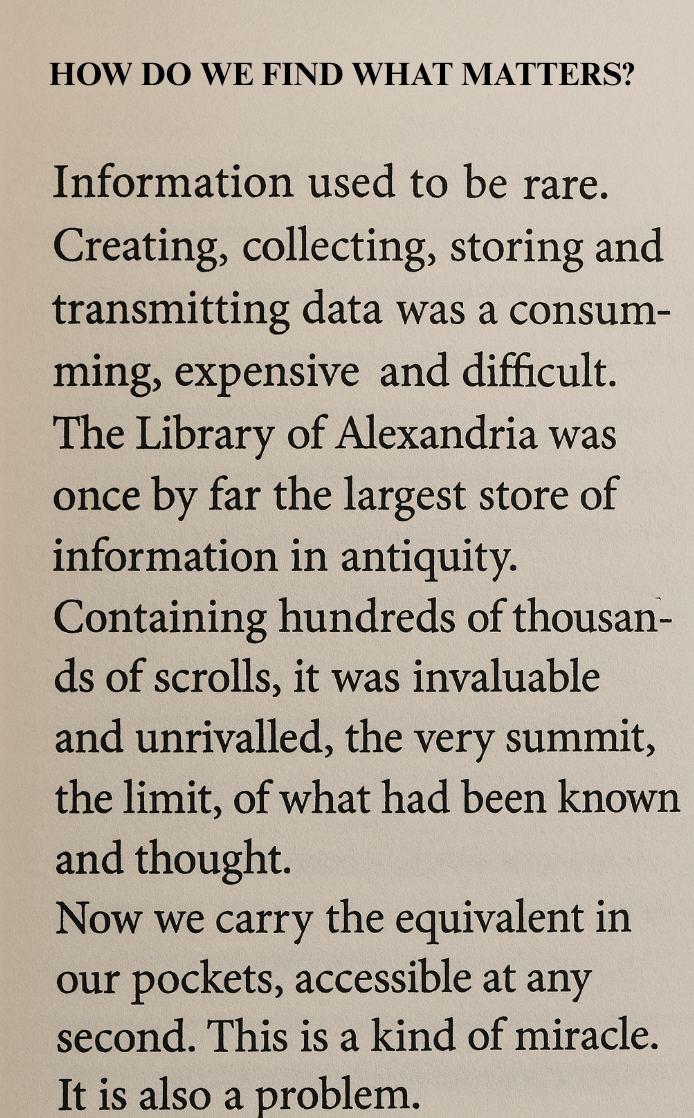
We have everything our ancestors could’ve dreamed of; fast fashion cheaper than coffee, infinite entertainment at our fingertips, and the knowledge of the world in our pockets.
We check our phones over 150 times a day, scroll past 10,000+ pieces of content, and still feel like we’ve missed something.
Recommended by LinkedIn

According to IBM, over 90% of the world’s data has been created in just the last two years.
More information isn’t making us more informed. Just more overwhelmed.
We feel anxious. Distracted. Paralysed. We’re drowning in abundance, but starving for clarity.
This is the hidden crisis of the modern world: too much of everything and no way to make sense of it. That’s why curation isn’t a buzzword. It’s a necessity. In every industry, and every part of life. Curation helps us navigate the noise. It replaces endless choices with meaningful options. It shifts the focus from what’s available to what’s appropriate.
We need to be able to focus on what actually matters. Because in today’s world, more isn’t a competitive advantage, it’s a distraction.
The advantage now belongs to those who can choose less, but better.
And the brands, platforms, and people who understand this will be the ones we trust the most. Curation is no longer optional. It’s the lens through which modern life must be filtered.