 Cameron Armstrong
The Double Reckoning - Why advertising is the one industry facing two revolutions at once.
Fifteen years ago, software started eating the world. Retail, banking, taxis, television, music, dating, logistics. Every industry Marc Andreessen named and most of the ones he didn't.
Except one. It never fully ate advertising.
That sounds absurd on the face of it. Advertising looks like the most digitised industry on earth. Two thirds of digital ad spend flows through three platforms. Real-time auctions. Algorithmic bidding. Impressions traded in milliseconds.
Look closer. Software ate the spend. It never ate the work.
To be fair, even the spend took its time. Attention shifted gradually and ad spend even slower.
Trading television or outdoor programmatically needed technology that didn't exist in 2010. And commercial deals held everything in place: annual negotiations, volume commitments, trading agreements that kept everyone gripping an old world as it dissolved underneath them.
But dissolve it did. Money that lived in print, linear TV and roadside posters moved channel by channel into the machines. TV is becoming connected and programmatic. Out-of-home is becoming digital and dynamically traded. Audio is following.
The US is a chapter ahead. The UK is on the same road. Hate it or love it, the world is now addressable.

And here's the strange part. Everything changed and nothing changed, at the same time.
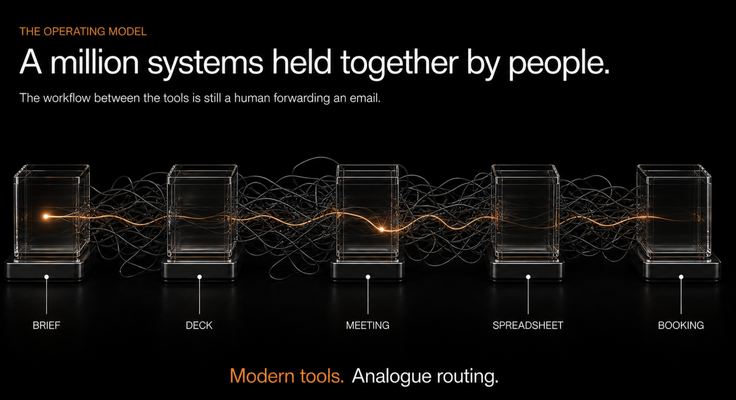
A campaign in 2026 is still made the way it was made in 2006. A brief lands in an inbox, gets rewritten into a deck, presented in a meeting, revised in another meeting, translated into a spreadsheet, booked through Prisma and DDS, systems older than half the people operating them, and reconciled by hand in Excel.
The pound travels at the speed of light. The thinking travels at the speed of PowerPoint.
Every other industry rebuilt its internal operations in software. Advertising outsourced that rebuild to somebody else. Walk any agency floor and you can see the consequence. A million systems held together by people. Teams, Excel, DDS, PowerPoint, buying platforms, holding company operating systems that don't talk to each other. Big meetings to align on other meetings. Status calls about work nobody has started.
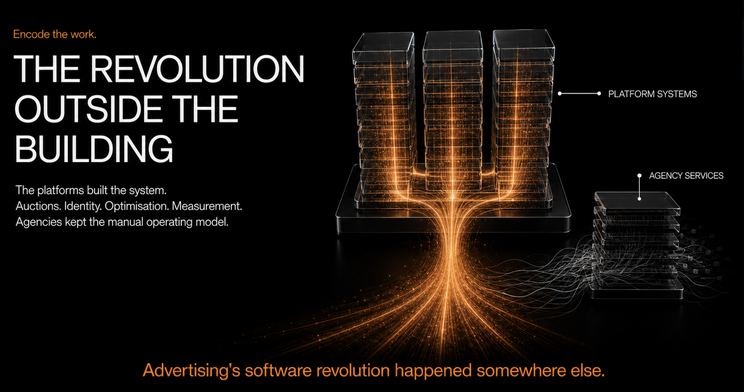
The revolution that happened outside the building
The reason wasn't laziness. It was incentives and complexity: these companies are too big and too rigid in the way they work to rewire themselves mid-flight, so the safest strategy was always to leave the machine alone.
Agencies price people. The FTE, the hour, the retainer built off a staffing plan. Software that removes people attacks revenue at the source. For two decades, the economics of this industry quietly punished the exact efficiency that transformed everyone else. Agencies didn't refuse the software revolution. They had no commercial reason to want it inside the building.
Yes, the industry bought tools. Bid scripts, dashboards, DCO, automation at the edges. But point solutions bolted onto an unchanged operating model are not a software revolution. The workflow between the tools is still a human forwarding an email.
And when somebody did try to change the operating model inside a big agency,, it died in the same three places. Politics, because transformation threatens whoever's empire it touches. Commercials, because nobody reopens a fee model mid-contract. Structure, because teams are organised around channels the new way of working would dissolve.
None of those are technology problems. They're the reasons the technology never got a chance.

Meanwhile Google, Meta and Amazon took the market. Not just because they held attention, but because they built quantifiable systems. Put a pound in, watch two come out, tracked to the penny. Quick, easy, and past a certain point questionable on incrementality. What you can't dispute is the foundations. The exchanges, the identity graphs, the optimisation engines, the measurement.
Advertising's software revolution happened entirely at companies that are not advertising companies. Agencies and publishers are still sat there wondering how they lost that much spend, and that much decision-making power, to three businesses.
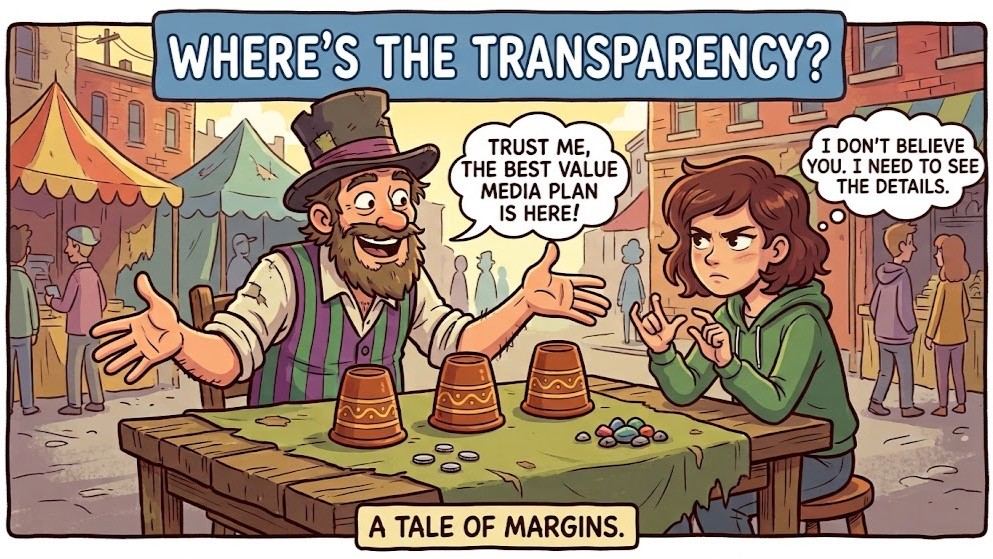
We know what it cost. When PwC traced the programmatic supply chain, roughly half of every advertiser pound reached a publisher, and fifteen pence vanished into a delta nobody in the chain could account for. It took an industry taskforce and two years of manual archaeology just to find out where digital money went and uncover billions of dollars in wasted spend. Nobody stole anything. That is the exhaust of digital money running through analogue institutions. The pipes were modern. The organisations pumping money through them were not.
For a while, that was survivable. The pipes were genuinely complex, judgment about them was scarce, and opacity had an alibi: do this badly and not even the buyer knows where the money truly goes. Both protections are gone. Advertisers no longer accept ways of working they can't see through. And the judgment needed to see through them now costs nothing.
What does an agency actually sell?
Not media. The platforms sell media. Not ads. Production sells ads.
An agency sells judgment. Which audience, which channel, which moment, which trade-off, what an impression is actually worth. Applied expertise, priced by the hour. The entire commercial construct of this industry is a bet that expert judgment stays scarce.
That is precisely the commodity whose price is collapsing. And for the first time you don't need access to a priesthood of ad experts to get it. The judgment is being democratised to everyone. Including the clients.
Two reckonings in one
Most industries face one transition. They did their software revolution twenty years ago. Their data is structured, their workflows encoded, their processes legible to machines. When intelligence arrives, it lands on prepared ground. Hard, but one transition.
Advertising deferred its first transition. So it faces both at once.
Recommended by LinkedIn


It has to do the software revolution it skipped, systematising how work moves, replacing the deck-and-meeting routing layer, structuring decades of unwritten knowledge, at the exact moment intelligence commoditises the judgment it sells.
The operational debt and the existential threat arrived on the same day.
And there's a crueller detail. Other industries fund their intelligence transition with the productivity gains banked from their software one. Agencies have to fund both, from a fee base priced in the unit that's deflating. Human hours.
An industry that never learned to encode its own process now has to encode its own expertise. In one motion. Under time pressure. While the money runs downhill.
The excuses stop working
For twenty years there was a get-out clause. Change could stall on politics and commercials because clients had nowhere else to go. The complexity was the moat.
That's gone. An advertiser can stand up in weeks what used to take an agency department. The platforms sell to them directly. The answers that used to end a difficult conversation, that's how the systems work, that's how the teams are structured, that's not how the fee was scoped, now end the relationship instead.
Clients won't accept them, because for the first time they don't have to.
Which forces the only question that matters, the one the industry has been able to avoid asking out loud: what is an agency actually for?
The trap
If everyone rents the same intelligence from the same vendors, nobody has an edge. For agencies the trap is sharper, because differentiation was already thin. Walk through any new business process and the decks already sound alike. Same frameworks, same platforms, same case study structure. Hand every one of those agencies the same models, plugged into the same generic workflows, and the convergence completes itself.
Rent generic intelligence, pipe it into generic process, and you haven't transformed. You've become interchangeable. Interchangeable services compete on one thing. Price.
The race to the bottom that broke programmatic runs again. This time on thinking.
But the inverse is also true, and this is what the doom narrative misses.
Agencies sit on some of the richest expertise deposits of any industry on earth. Decades of effectiveness science. Category memory that predates the people running the accounts. Pattern recognition about what worked, for which brand, in which market, and why. Almost none of it is written down. It lives in senior heads, gets diluted through every handover, and walks out the door with every restructure.
For twenty years that couldn't be systematised, because encoding it required engineering and engineering was expensive. That constraint is gone.

What the other side looks like
Advertising likes to believe it's unique. But another service based industry is already a chapter ahead, and it's worth watching closely. Law.
Harvey and Legora took the judgment of lawyers, the drafting, the review, the precedent work, and encoded it into systems that some of the world's biggest firms have now adopted. The firms that moved early didn't dissolve into utilities. The machine took the drafting and gave the lawyers back the counsel. The expertise didn't disappear. It moved up the stack, exactly where the value always was.
The same shift is available here, and it runs in a sequence. Context becomes the moat: the client knowledge, the category memory, the effectiveness evidence, everything your agency knows that the model doesn't. Skills become interchangeable: the individual tasks, the plan, the deck, the report, commoditise first and fastest. And an operating system takes over the day-to-day: the routing, the reconciliation, the status theatre that currently consumes most of the working week.

What comes back?
Time. And this is where the fear gets the economics backwards.
Efficiency doesn't shrink the work. It multiplies it. Every brief currently rushed, every test nobody can afford to run, every market nobody can cover, every idea that dies in a prioritisation meeting because there aren't enough hours. All of it becomes doable. The constraint was never demand for thinking. It was the cost of producing it.
The job stops being operating a channel and starts being having ideas worth operating.
Which surfaces the real warning. If the only thing an agency encodes is process, it becomes a utility. And nobody has ever fallen in love with a utility.
Execution is becoming a commodity. The thing that makes a person stop scrolling, laugh, feel something, want something they didn't know they wanted, is not. The point of encoding the operations was never to replace the magic. It's to stop the magic suffocating under admin.
So the survival math is simple to state, if not simple to do. Encode your context, because that's the moat. Systematise your operations, because that's the time. Prove your effectiveness, because in this industry if you can't prove it works, you don't exist. Then spend every hour the machine gives back on the one thing it can't do. Making people feel.
Software never ate advertising. Intelligence won't be so polite.
I know which version I'm helping to build.