 Cameron Armstrong
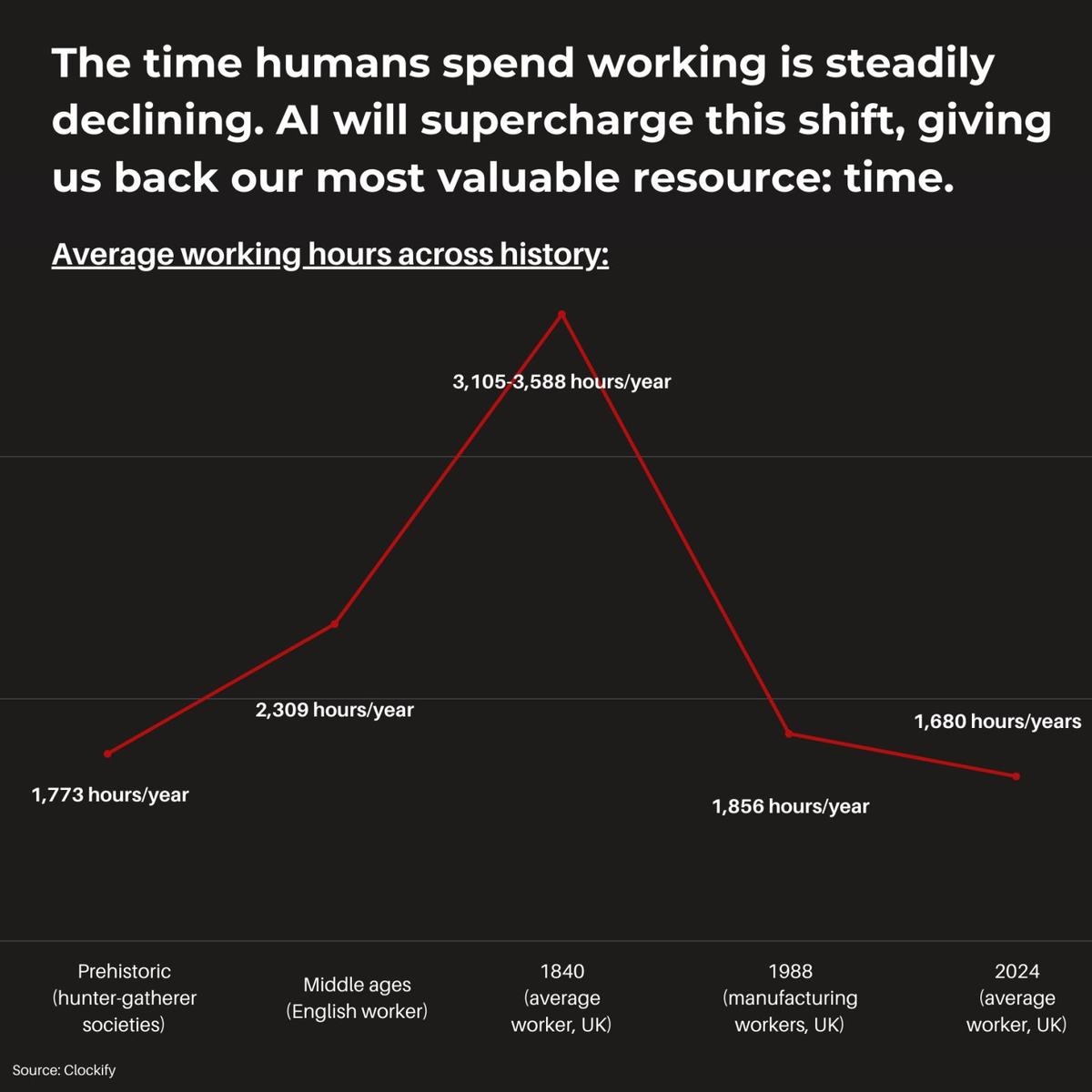
Throughout history, our relationship with work and free time has evolved dramatically.
In the beginning, we were foragers, living closely with nature, guided by the rhythms of the earth.
Then agriculture changed everything. We moved from surviving to producing, and with it came a new pressure: more productivity, and less free time.
Fast forward through the Industrial Revolution: machines made production faster, but it wasn’t until workers fought for their rights that the 7-day grind became the 5-day workweek, and in some places, now even 4.
Today, we’re on the edge of another seismic shift: AI and automation are removing tedious tasks from our lives.
And as they do, they’re unlocking an exponential rise in productivity.
For the first time, we’ll produce more, not by working harder, but by working less.
Tasks that once drained hours will be done in minutes.
Entire workflows will be automated, leaving humans to focus on creativity, strategy, and experience.
More output. More opportunity.
And critically, more free time.
Soon, more people will have the luxury to refocus their energy, not just on work that pays the bills, but on what truly matters to them.
We are returning, in a sense, to our roots.
Not foraging for food, but for meaning.
Not racing to produce, but searching for experiences.
This is why I’m so bullish on the experience economy. Both physical and digital.
As AI takes care of the “doing,” humans will double down on “being.”
Whether it’s travelling the world, building immersive digital spaces, participating in community events, or diving into creative pursuits, experiences will be the new currency.
The future isn’t about more things. It’s about more experiences.