 Cameron Armstrong
Winston Churchill used to lay 200 bricks per day to keep his mind busy when feeling down.
Not because he needed a wall.
He did it to give his hands something to do and keep a depressive mind busy.
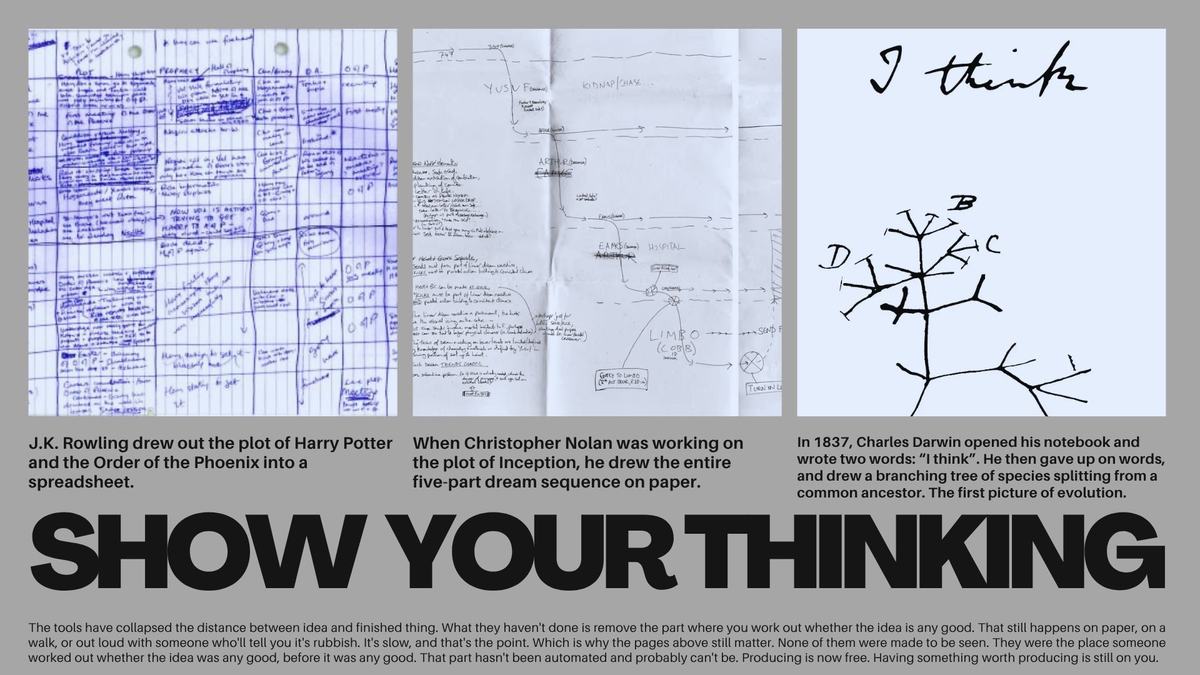
Charles Dickens walked twenty to thirty miles around London when the writing wouldn't come. Nolan drew the entire five-part dream sequence of Inception onto one sheet of paper before he shot a frame. Darwin's first picture of evolution was a scruffy little tree in a notebook with two words above it: "I think."
None of them were short on intelligence. They were short on clarity. And clarity comes from getting the thought out of your head and into your hands.
Building is no longer the hard part.
You can go from idea to working thing in an evening now. A solo founder ships what took a department a year. Even a media team can build a tool in an afternoon that would have gone into a development queue and died there.
All of that is real and all of it is good. But the speed has a side effect nobody talks about.
When something takes a long time, you're forced to understand it. You argue about it, you draw it on a whiteboard, you explain it to someone who pushes back. The understanding was never a separate step, it was a by-product of the slowness. Take the slowness away and it quietly goes too.
There’s been times I’ve built things with AI which look cool, but I can barely explain them, never mind understand them.
So for me, best way to plan hasn’t changed, I map it out on paper or a whiteboard first. Boxes and arrows, what goes in, what comes out. It may be as little as half an hour, and it’s consistently the most valuable half hour of the whole thing.
Use AI as a sparring partner and an enable. Don't hand it the fight.
Close the laptop and draw the thing out by hand, then built fast, test, iterate and go again.
The plays haven't changed. Think clearly, then act.We've just made it much easier to skip the first bit.
A lot of the good analogies within this, credit goes to George Mack - writes some fascinating essays.