 Cameron Armstrong
Netflix is dumbing down dialogue and they're probably right to.
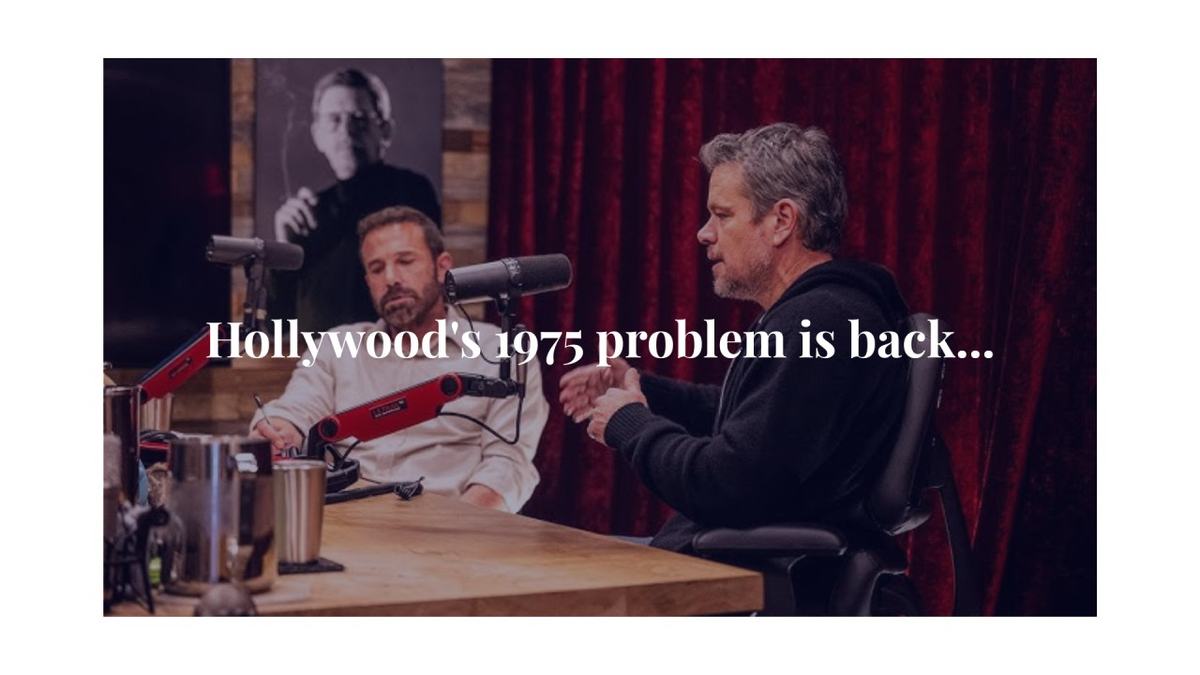
Matt Damon and Ben Affleck went onto Rogan recently and gave some fascinating insights into how the film-making landscape is changing.
Netflix explicitly asks writers to repeat plot points 3-4 times throughout a film. Why? Because viewers are on their phones. If you miss a line, you've lost the thread.
It doesn't stop there.
Action films now front-load the spectacle. Traditional structure was three set pieces ramping up across three acts, save the big money for the finale. But streaming has to hook you in five minutes or you're gone. So the major battle comes first.
Directors have stopped obsessing over cinematography. Why bother when most people are watching on a phone propped against a cereal box?
The economics explain it. An independent film with a $25m budget needs another $25m for marketing. Split the box office with the theatre and you need $100m gross just to break even. Streaming removes that pressure. More bets. More risk. More projects that would never survive theatre economics.
But here's the thing which may surprise you: we've been here before.
Before 1975, Hollywood was getting hollowed out by TV. It was the same story; the habit moved into the living room. Cinema had to justify leaving the house.
The industry responded with spectacle, then with authenticity. New Hollywood gave us films that felt real, risky, character-led. Then Jaws created the blockbuster event model.
Cinema survived by doing what TV couldn't replicate.
And that needs to be the play today.
Attention isn't dead. It's selective. People watch three-hour podcasts. They sit through entire football matches. They'll commit to long-form when it feels worth it.
The problem isn't human attention spans. It's that most content isn't worth the attention.
Cinema doesn't need to compete with short-form on its terms. It needs to double down on what the sofa can't replicate: the premium social ritual, true event storytelling, experiences that feel meaningfully different.
Later in that same podcast, Damon talked about Dwayne Johnson's hospital scene in The Smashing Machine, raw, emotional, drawing on real trauma. AI couldn't write that. It couldn't perform it. The messy, lived human experience that makes a moment land.
That's what film has that algorithms don't.
The demand for at-home viewing will shape some filmmaking. That's just supply meeting demand.
But the films that endure will be the ones that gave people a reason to leave the house.
Film has always adapted. The question is whether it adapts by dumbing down or by doubling down.