 Cameron Armstrong
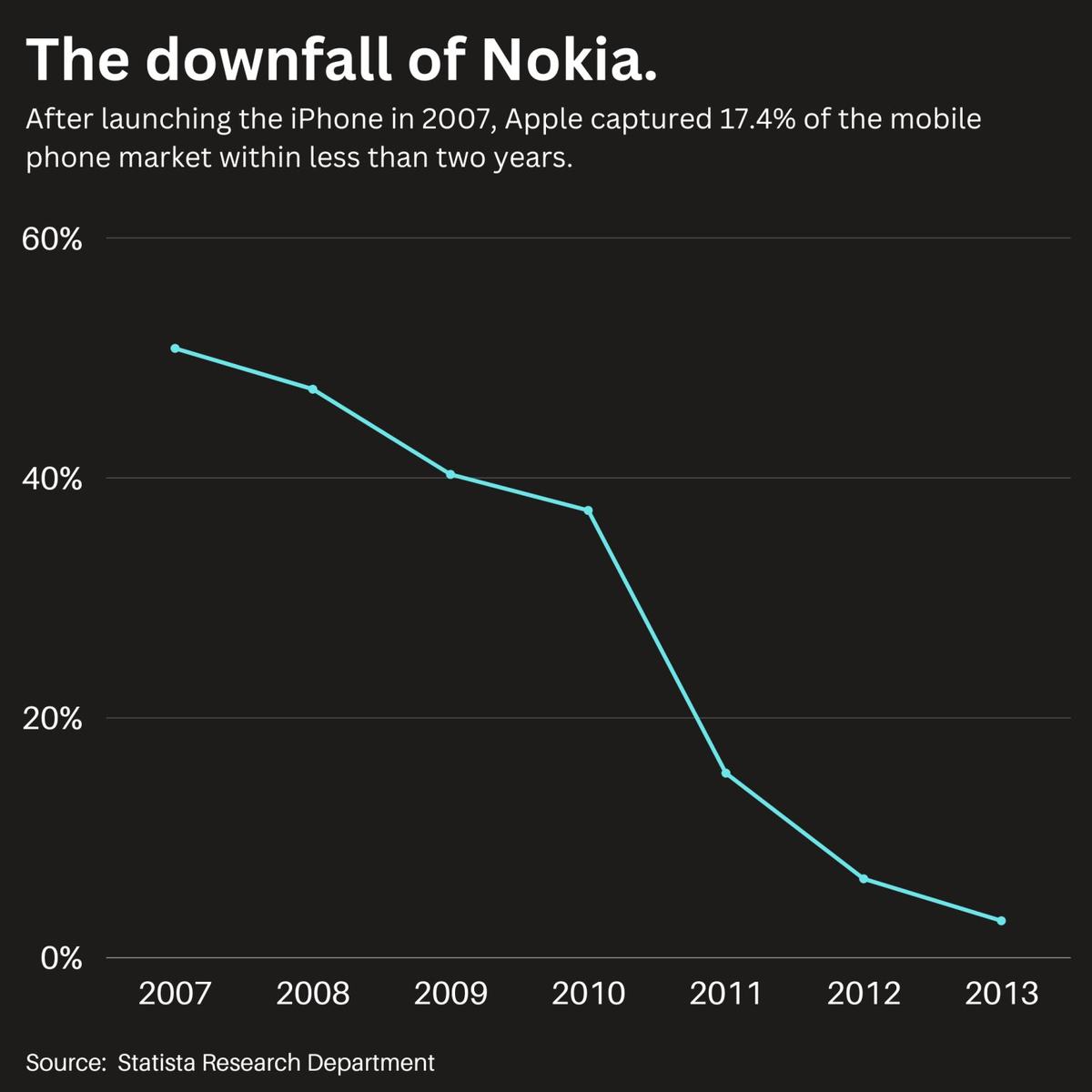
In the early 2000s, there was one company that was selling half the smartphones on the planet…
In the early 2000s, there was one company that was selling half the smartphones on the planet and became the most valuable company in Europe as a result.
A Business Week cover declared "Nokia is synonymous with success."
Nokia could do no wrong.
But then 10 years later, the company was irrelevant. Selling its mobile business in 2013 and losing roughly a quarter of a trillion dollars in valuation.
Why did Nokia have such a large fall from grace and how did they let the technological revolution of the smartphone pass them by?
In 2004, a handful of excited Nokia engineers created a new kind of phone: internet-ready, with a touchscreen display and camera. They proposed another crazy idea to go along with the phone: an online app store.
The leadership team-the same widely admired, cover-story leadership team, shot down both projects.
Three years later, the engineers saw Steve Jobs unveiling the future. The iPhone.
The same crazy ideas had materialised, but not through Nokia. But Apple, a complete newcomer to the smartphone industry.
A wildly innovative team at Nokia had turned and this was the start of the end.
What happened to this team of highly skilled innovators and successful leaders?
Ultimately leaders can preach innovation and build a culture, but they can’t drive change alone.
Small changes in structure, rather than culture, can transform a rigid team and revolutionise the speed at which teams work.
Failure needs to be accepted and celebrated. Yet few are willing to embrace it.
The most innovative companies have a genuine curiosity as to why. Why products fail, why systems aren’t working, why customers are looking elsewhere.
Rather than stopping at the first hurdle, the odds of success increase when you dive into the underlying reasons as to what went wrong.
An outcome mindset needs to be changed to a system mindset, understanding the process which made you arrive at each decision and how this can be improved moving forward.
While the principles of how large companies innovate may differ, there’s one constant in a changing world. Those who embrace change will survive, while those who stay static will be left behind.
Nobody has heard of the Amazon Fire Phone. Amazon took a $170 million write-off on the failed product.
“You can’t, for one minute, feel bad about the Fire Phone. Promise me you won’t lose a minute of sleep,” Bezos told the Fire Phone’s team.
Failure has to be a part of growth.
Amazon's failure led to the same team, to develop the Amazon Echo and Alexa, the success stems, in part, from Amazon’s willingness to take chances and experiment.
This mindset is why they’re one of the most valuable companies in the world.
30 years ago, the corporate conglomerates of today hadn't been heard of, or in some cases even founded.
No matter who you are, no matter how big you are, no matter what industry, staying on top is always the challenge.